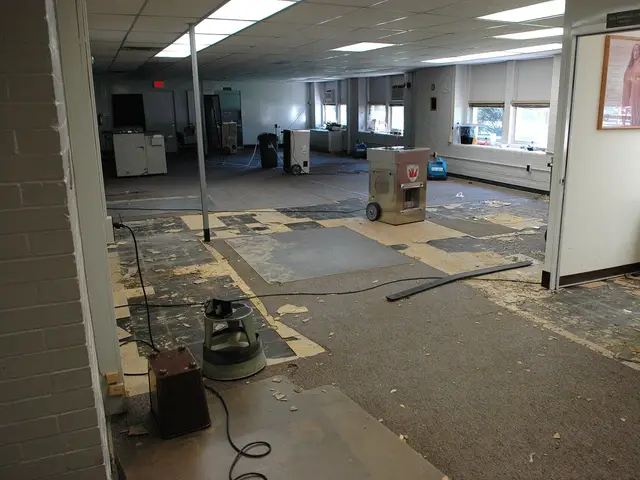
Commercial water damage restoration starts with the same three moves as at home, only faster because a business is losing money every hour it is closed: shut off the water, cut power to wet areas, and keep staff and customers out of them. Then call your insurer and a restoration company the same day. One free call connects you with an independent local restoration company, lines are open 24/7. The Insurance Information Institute notes that business interruption cover typically has a 48 to 72 hour waiting period, so documenting the start of the loss matters.
The next 10 minutes
- Stop the source. Know where the main water shutoff and any fire sprinkler control valve are. Only shut a sprinkler valve if there is no fire, and tell your fire alarm monitoring company.
- Isolate power to wet areas through the panel, and keep people away from wet electrical equipment, servers and point-of-sale stations.
- Turn off HVAC zones serving the wet area. EPA's guidance for commercial buildings is not to run the HVAC system if you know or suspect it is contaminated with mold.
- Clear the area and post signs. Wet floors in a public space are a slip hazard.
- Photograph and video everything, including stock, equipment and the source.
- Call your insurer, your property manager or landlord, and a restoration company.
What the crew does in a commercial building
The ANSI/IICRC S500 Standard for Professional Water Damage Restoration covers residential, commercial and institutional buildings. The process is the same as a home, but larger and more planned:
- Site assessment. Source, water category, affected square footage, and which parts of the building can stay open.
- Moisture mapping across floors, walls and ceilings, including multiple suites or floors below.
- Extraction with larger truck-mounted or portable units and pumps.
- Controlled demolition of wet ceiling tiles, carpet tiles, drywall and insulation where they cannot be dried.
- Drying with commercial air movers, large dehumidifiers and sometimes temporary power or desiccant units for big spaces.
- Containment and phasing so occupied areas stay clean and usable.
- Daily monitoring and documentation for the owner, tenants and insurers.
If mold is already present, EPA's commercial building guide recommends limited containment (single 6-mil fire-retardant plastic) for 10 to 100 square feet and full containment with double barriers and an airlock for more than 100 square feet. EPA also stresses communicating with building occupants throughout the process.
Water still spreading?
One free call connects you with a local restoration company. Lines are open 24/7 and there is no obligation.
What commercial water damage restoration costs
There is no reliable national average for commercial jobs, since a dentist's office and a warehouse have little in common. Restoration companies usually quote after inspecting. Published rates still give a useful guide:
| Item | Typical cost (Fixr) |
|---|---|
| Clean water extraction | $3.75 to $4.25 per sq ft |
| Gray water extraction | $4.10 to $6.50 per sq ft |
| Sewage (black) water extraction | $7 to $7.50 per sq ft |
| Drywall restoration | $1.50 to $3 per sq ft |
| Carpet restoration | $4.75 to $10.50 per sq ft |
| Restoration labor | $70 to $200 per hour |
| Class 3 water damage | $1,000 to $3,000 |
| Class 4 water damage (deep saturation of dense materials) | $20,000 to $100,000 |
After-hours work, temporary power, phased schedules and specialty contents (records, inventory, electronics) add to the price. The water damage cost calculator gives a starting figure by area and water category, and the guide to water damage categories and classes explains the terms on a commercial estimate.
Insurance and business interruption
Commercial property policies usually cover sudden water losses like burst pipes and sprinkler discharge, subject to the policy wording. Flood is the big gap: the Insurance Information Institute says there is no coverage for flooding in most commercial property insurance policies. NFIP flood policies for non-residential buildings are capped at $500,000.
Business interruption (business income) coverage, per the Insurance Information Institute, can pay lost net income, rent or lease payments, loan payments, taxes and payroll during the period of restoration. It typically starts after a 48 to 72 hour waiting period, standard policies limit the restoration period to 30 days unless extended by endorsement (up to 360 days), and it only applies if the underlying property damage is covered. Keep records of the date and time the loss started and when operations stopped. More on documentation is in the water damage insurance claim tips.
How long it takes
Extraction and setup usually start on day one. Drying a commercial space commonly takes several days, longer for concrete slabs, multiple floors or Class 4 losses involving hardwood, plaster or masonry. Rebuild and reopening depend on the scope. Phasing work by area often lets part of a business reopen before the whole job is finished. See water mitigation vs restoration for how the emergency phase differs from the rebuild.
What you can do while you wait
- Move inventory, records and equipment off wet floors and away from drips.
- Unplug or power down electronics in the wet area, if the outlets are dry.
- Notify tenants or neighboring suites. Water travels between units.
- Start a log: time of discovery, who was called and when, and what was moved.
When it becomes dangerous
- Water is near electrical rooms, panels, server racks or elevator pits.
- Sewage or contaminated water is involved. That is Category 3, and porous materials it touched usually have to be removed.
- Ceilings are sagging, especially suspended ceilings loaded with wet tiles and insulation.
- The building houses vulnerable people (healthcare, childcare, senior living), where mold and contamination carry extra risk.
What to ask on the phone
- Do you handle commercial losses of this size, and how many crews can you put on it?
- Are your firm and technicians IICRC certified? The IICRC offers a locator to check.
- Can you phase the work so part of the business stays open?
- Do you provide daily moisture logs and documentation for the insurer and the landlord?
- Can you supply temporary power or work after hours if needed?
- Who handles the rebuild, and how is the job priced?
Water still spreading?
One free call connects you with a local restoration company. Lines are open 24/7 and there is no obligation.
The call is free and there is no obligation to hire. For property managers with homes or rental units as well, the emergency water removal page covers the residential side.
Common questions
How much does commercial water damage restoration cost?
Commercial jobs are normally quoted after an inspection because size and building type vary so much. Published per-square-foot rates from Fixr give a guide: about $3.75 to $4.25 for clean water extraction, $4.10 to $6.50 for gray water and $7 to $7.50 for sewage water, with severe Class 4 losses at $20,000 to $100,000.
Does business insurance cover water damage?
Commercial property policies usually cover sudden water damage such as a burst pipe or sprinkler discharge. The Insurance Information Institute notes there is no flood coverage in most commercial property policies, so rising water needs a separate flood policy.
Will business interruption insurance pay while we are closed?
It can, if the closure was caused by physical damage the property policy covers. The Insurance Information Institute says it typically has a 48 to 72 hour waiting period and covers lost net income, rent, loan payments, taxes and payroll during the restoration period. It does not cover flood losses unless flood is covered elsewhere.
Can a restoration company work around business hours?
Many can stage work by area, run drying equipment overnight and use containment so part of the building stays open. Ask about it on the first call, along with noise, power draw and how they will keep equipment out of public walkways.
What standard should a commercial restoration company follow?
The ANSI/IICRC S500 Standard for Professional Water Damage Restoration applies to residential, commercial and institutional buildings. For mold, the IICRC S520 standard and EPA's guide for schools and commercial buildings set out containment based on the size of the affected area.
Sources
- IICRC: ANSI/IICRC S500 Standard for Professional Water Damage Restoration
- EPA: Mold Remediation in Schools and Commercial Buildings Guide, Chapter 3
- Insurance Information Institute: Do I need business interruption insurance?
- Insurance Information Institute: Spotlight on flood insurance
- Fixr: Water Damage Restoration Cost
- IICRC: Water Damage Restoration Technician (WRT) certification